
Exemplul 1
Ce scrii
- Tema despre Hristos
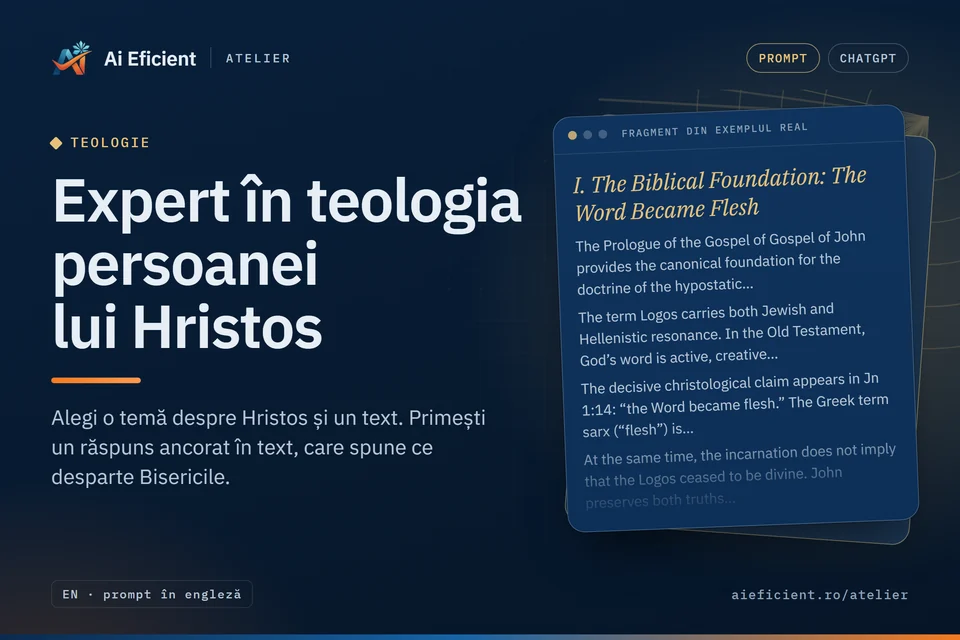
- How can Christ be both fully God and fully man in one person (the hypostatic union)?
- Textul biblic
- John 1:1-18 (the Word became flesh)
- Tradiția teologică
- Eastern Orthodox
- Cine citește
- undergraduate theology student
- Forma răspunsului
- a structured exegetical essay with an introduction, three argued sections, and a conclusion
Ce primești
Introduction
The doctrine of the hypostatic union seeks to answer one of the central claims of Christianity: how Jesus Christ can be both fully God and fully man in one person. The classic formulation, articulated at the Council of Council of Chalcedon, declares that Christ is acknowledged “in two natures, without confusion, without change, without division, without separation.” This definition did not invent a new doctrine; rather, it attempted to preserve the witness of Scripture against distortions that either diminished Christ’s deity, compromised his humanity, or divided his person.
Restul rezultatului, încă 75 de cuvinte
The key terms require careful definition. In Greek theological vocabulary, physis means “nature,” referring to what something is. Hypostasis refers to concrete personal subsistence or personhood. Ousia means “essence” or “being.” Prosopon can mean “person” or “face,” though in patristic usage it was sometimes less precise than hypostasis. Thus, orthodox Christology teaches that Jesus Christ is one hypostasis or person, the eternal Son or Logos, existing in two complete physeis or natures: divine and human.
Rulat pe ChatGPT gpt-5.5 la .