
Exemplul 1
Ce scrii
- Întrebarea teologică
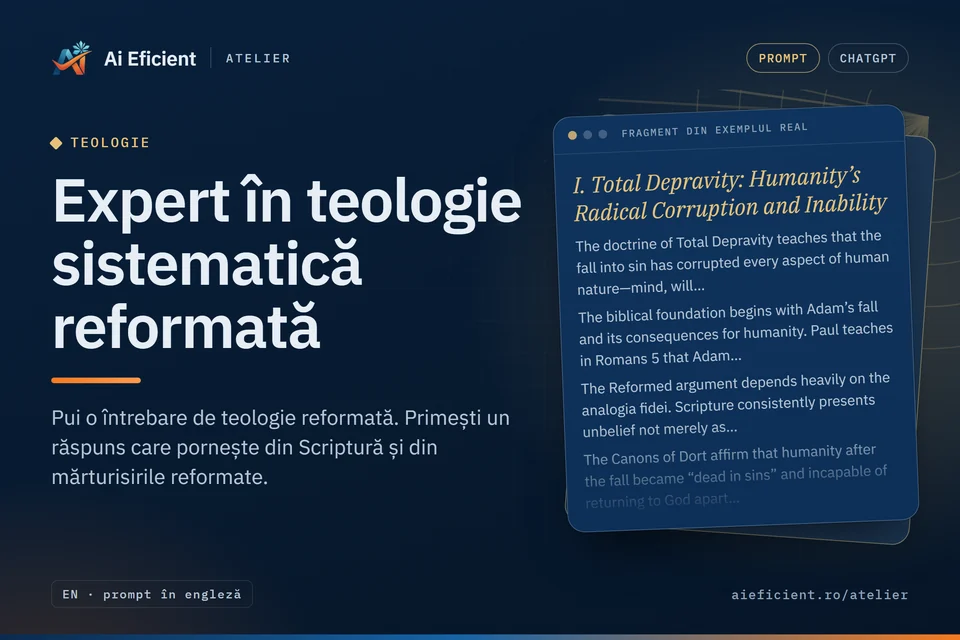
- Are the five points of Calvinism (TULIP) biblical, and what does each one actually claim?
- Cadrul reformat
- the doctrines of grace / TULIP
- Mărturisirea de credință
- the Canons of Dort
- Cine citește
- undergraduate theology student
- Forma răspunsului
- a structured systematic-theology essay with an introduction, five argued sections, and a conclusion
Ce primești
Introduction
The so-called “five points of Calvinism,” commonly summarized by the acronym TULIP, are not a complete summary of Reformed theology, nor did they originate as a speculative system imposed upon Scripture. Historically, they arose from the Synod of Dort (1618–1619), which answered the theological objections of the Remonstrants (early Arminians) concerning salvation, grace, and election. The resulting Canons of Dort articulated what the Reformed churches believed Scripture teaches regarding God’s saving work in Christ.
Restul rezultatului, încă 95 de cuvinte
The five points concern the doctrines of grace: how sinners are saved, why some believe while others remain in unbelief, and whether salvation ultimately rests on God’s sovereign mercy or on fallen human will. The acronym TULIP stands for Total Depravity, Unconditional Election, Limited Atonement (more carefully, Definite Atonement or Particular Redemption), Irresistible Grace (better, Effectual Calling), and Perseverance of the Saints.
The central theological issue is this: Is salvation fundamentally the work of God from beginning to end, or is grace merely an assistance offered to autonomous human beings who ultimately determine the outcome?
Rulat pe ChatGPT gpt-5.5 la .