
Exemplul 1
Ce scrii
- Obiecția de tratat
- Does the universe need a cause, and does that cause have to be God?
- Argumentul ori abordarea
- the Kalam cosmological argument
- Tipul de dovezi
- philosophical reasoning
- Cine citește
- a curious skeptic with no philosophy background
- Forma răspunsului
- a structured essay with an introduction, three argued sections, and a conclusion
Ce primești
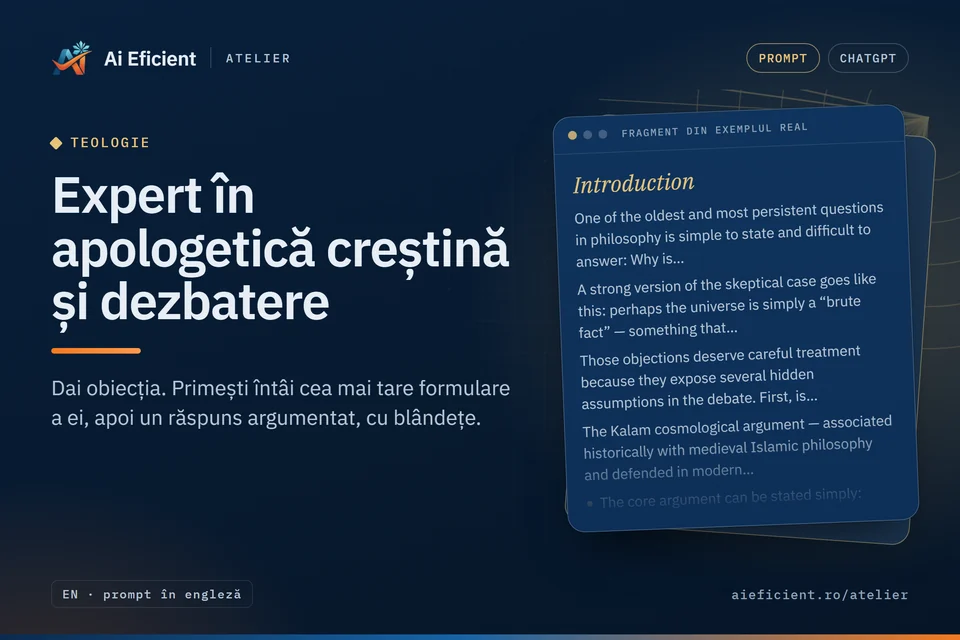
Introduction
One of the oldest and most persistent questions in philosophy is simple to state and difficult to answer: Why is there something rather than nothing? The modern version of this question often appears as an objection to belief in God: “Why think the universe needs a cause at all? And even if it does, why call that cause ‘God’ rather than some unknown natural process?”
Restul rezultatului, încă 127 de cuvinte
A strong version of the skeptical case goes like this: perhaps the universe is simply a “brute fact” — something that exists without explanation. Or perhaps quantum physics shows that things can appear without causes. Even if the universe had a beginning, it does not obviously follow that the cause is a personal Creator rather than an impersonal law or multiverse. And critics often add a further challenge: if everything needs a cause, then God would need one too.
Those objections deserve careful treatment because they expose several hidden assumptions in the debate. First, is the universe the kind of thing that can explain itself? Second, can something begin to exist uncaused? Third, if the universe has a cause, what properties would that cause need to have?
Rulat pe ChatGPT gpt-5.5 la .