Sari la conținut

Prompt · Teologie

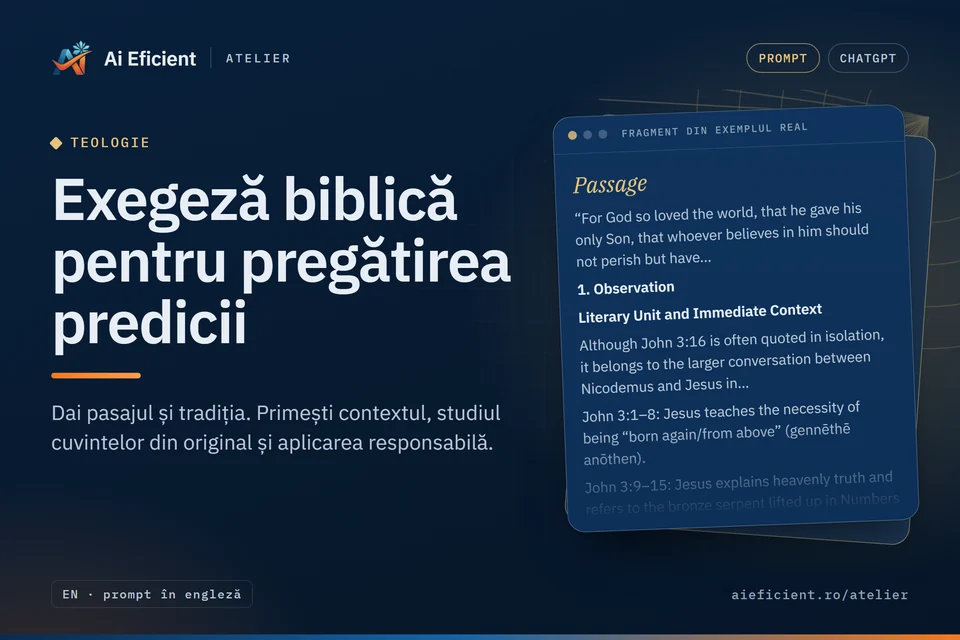
Exegeză biblică pentru pregătirea predicii

Titlu original: Bible Exegesis Sermon Prep Expert

Dai pasajul și tradiția. Primești contextul, studiul cuvintelor din original și aplicarea responsabilă.

  • Prompt
  • Merge în ChatGPT
  • Testat pe gpt-5.5
  • 2 exemple reale
  • Promptul e în engleză; răspunde în engleză (limba promptului)
  • Disponibil
Copertă: Exegeză biblică pentru pregătirea predicii. Prompt pentru ChatGPT, categoria Teologie.

Fișa produsului

Disponibil
Preț49 lei
Tip
Prompt
Domeniu
Teologie
Rulează în
ChatGPT
Primești
PDF
Ultima actualizare
Cumpără · 49 lei

La pasul următor completezi datele pentru factură. Plata se face online, cu cardul.

Cere versiunea pentru firma ta

Apel gratuit, 30–45 de minute, luni–vineri, 12:00–16:00.

Ce obții

Primești o exegeză istorico-gramaticală completă a oricărui pasaj biblic: observație literară, context istorico-cultural, studiul cuvintelor în ebraică și greacă, gen și structură, teologie canonică și centrată pe Hristos, aplicare responsabilă. Pentru predicatori, lideri de studiu biblic și studenți. Semnalează înțelegerile greșite frecvente și nu inventează date lexicale.

Exemple: ce scrii, ce primești

Exemplul 1

Ce scrii

Pasajul biblic
John 3:16
Tradiția de interpretare
Reformed/evangelical
Accentul exegetic
original-language word study
Cine citește
lay Bible-study leader
Forma răspunsului
a structured exegetical commentary with clear sections (observation, historical context, lexical-grammatical analysis, theological synthesis, contemporary application)

Ce primești

Passage

“For God so loved the world, that he gave his only Son, that whoever believes in him should not perish but have eternal life.” — The Gospel of John 3:16 (ESV)

  1. Observation

Literary Unit and Immediate Context

Although John 3:16 is often quoted in isolation, it belongs to the larger conversation between Nicodemus and Jesus in John 3:1–21. The flow of thought matters:

Restul rezultatului, încă 117 cuvinte

John 3:1–8: Jesus teaches the necessity of being “born again/from above” (gennēthē anōthen).

John 3:9–15: Jesus explains heavenly truth and refers to the bronze serpent lifted up in Numbers 21.

John 3:16–21: The theological explanation of why the Son was sent and the division produced by human response to him.

There is some debate over where Jesus’ direct speech ends. Some interpreters think Jesus speaks through v. 21; others think the evangelist John inserts explanatory commentary beginning at v. 16. The Greek manuscripts do not contain quotation marks, so certainty is impossible. Either way, the statement carries Johannine theology and functions as inspired interpretation of Jesus’ mission.

Place Within the Gospel

John’s Gospel explicitly states its purpose:

Rulat pe ChatGPT gpt-5.5 la .
Exemplul 2

Ce scrii

Pasajul biblic
Psalm 23
Tradiția de interpretare
Eastern Orthodox

Ce primești

Psalm 23 — Verse-by-Verse Exegetical Study

  1. Observation: Literary Unit and Place Within the Psalter

Psalm 23 is a complete poetic unit attributed to David in the superscription (“A Psalm of David”). It belongs to Book I of the Psalter (Psalms 1–41). The psalm moves through two dominant metaphors:

God as shepherd (vv. 1–4)

God as host/king (vv. 5–6)

The poem progresses from provision → guidance → danger → vindication → communion.

Restul rezultatului, încă 118 cuvinte

A major structural feature is the shift in address:

In vv. 1–3, the psalmist speaks about God (“He…”).

In v. 4, during the valley of danger, he speaks directly to God (“You…”).

This shift is a powerful literary device: intimacy intensifies in suffering.

The psalm is Hebrew poetry, so meaning is carried not by rhyme but by:

parallelism,

imagery,

metaphor,

repetition,

movement of thought.

Verse 1

“The LORD is my shepherd; I shall not want.” (Ps 23:1)

Historical-Cultural Context

In the ancient Near East, “shepherd” was a royal metaphor. Kings were called shepherds because they guided and protected their people. David himself had literally been a shepherd (1 Sam 16:11), so the image is both political and personal.

Rulat pe ChatGPT gpt-5.5 la .

Ce completezi: 5 variabile

Pasajul biblic
Exemplu: John 3:16
Tradiția de interpretare
Exemplu: Reformed/evangelical
Accentul exegetic
Exemplu: original-language word study
Cine citește
Exemplu: lay Bible-study leader
Forma răspunsului
Exemplu: a structured exegetical commentary

Ce primești

  • PDF-ul cu promptul complet, în engleză
  • Pașii de folosire, în română
  • Tabelul variabilelor, în română
  • Exemple reale de ieșire, cu intrările lor

Detalii

Merge în
ChatGPT
Testat pe
ChatGPT, gpt-5.5
Limba promptului
engleză
Limba rezultatului
engleză (limba promptului)
Variabile
5
Exemple reale
2

Cum îl folosești, în 3 pași

  1. Copiezi promptul din fișierul primit.

  2. Completezi variabilele marcate cu datele tale.

  3. Îl lipești în ChatGPT și citești rezultatul înainte să-l folosești. Nu-l copia orbește.

Licență și garanție

Ce ai voie să faci cu promptul

Licența, pe scurt

Prompturi
[Text juridic de confirmat: licența promptului: folosești rezultatele cum vrei; promptul în sine nu se revinde și nu se publică]
Rambursare și suport
[de completat de Daniel: politica de rambursare și de suport]
Dreptul de retragere
[Text juridic de confirmat: acordul pentru livrarea imediată a conținutului digital și pierderea dreptului de retragere]Citește politica de retragere

Recenzii

Nu afișez nicio recenzie până nu există cumpărători reali. Nicio stea inventată.

Cine le face

Daniel Petru Pascu, Cons. Jr.

  • Licențiat în Drept la Universitatea de Vest din Timișoara (al 4-lea din 133) și master în Dreptul Afacerilor
  • Certificat profesional Google Cybersecurity
  • Certificat profesional Google IT Support
Despre mine și cum lucrez

Înrudite

Alte unelte din atelier

Tot catalogul

La comandă

Vrei promptul adaptat pe firma ta? Îl facem împreună. Apoi decizi tu.

Pornim de la un apel gratuit de 30–45 de minute. Îmi spui ce proces te încurcă; îți spun ce se poate face și cât costă. Întâi apelul gratuit, apoi preț fix pe proiect.

S05 De obicei devine: Produs la comandă. Automatizare de documente, bot de preluare a clienților, flux GDPR.

Apelul: gratuit, luni–vineri, 12:00–16:00.