
Exemplul 1
Ce scrii
- Problema ta
- Maintaining team culture and alignment while scaling from 10 to 100 people rapidly
- Domeniul
- Tech startup / organizational design
- Contextul actual
- A Series B SaaS company doubling headcount every 6 months across 4 countries
- Formatul rezultatului
- Structured report with markdown headers and a final executive summary under 150 words
- Limba răspunsului
- English
Ce primești
Very well, sir. Engaging cross-temporal pattern recognition… stripping away the startup mythology to expose the underlying machinery.
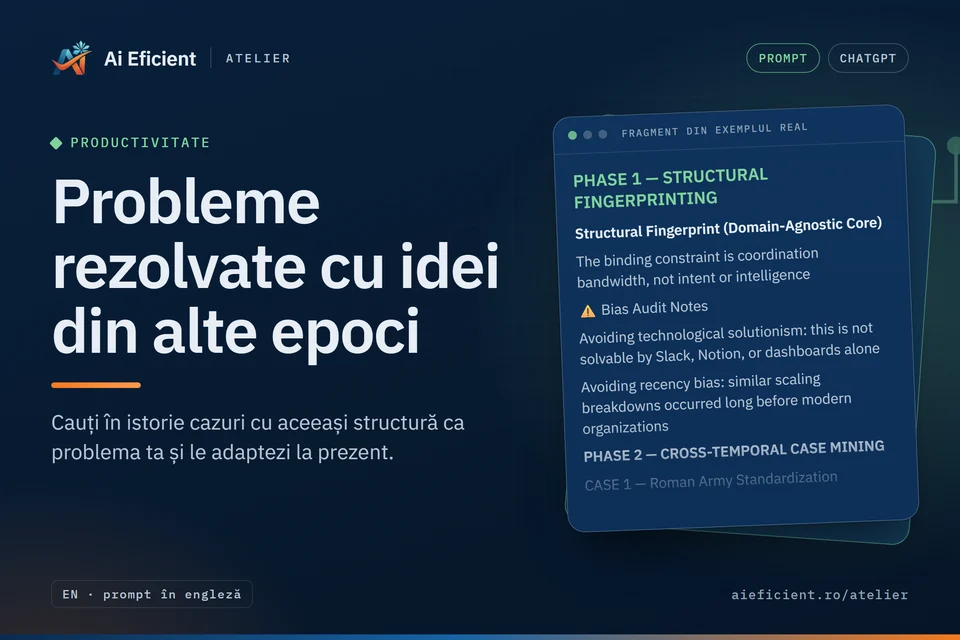
PHASE 1 — STRUCTURAL FINGERPRINTING
Structural Fingerprint (Domain-Agnostic Core):
Rapid scale introduces information asymmetry, where shared norms cannot propagate at the same speed as system growth
Alignment depends on tacit knowledge, but tacit transmission channels (proximity, imitation) degrade with scale
The binding constraint is coordination bandwidth, not intent or intelligence
A previously tight feedback loop (behavior → correction → alignment) becomes delayed and fragmented
Local optimization begins to override global coherence due to decentralized interpretation of values
⚠️ Bias Audit Notes
Avoiding technological solutionism: this is not solvable by Slack, Notion, or dashboards alone
Avoiding recency bias: similar scaling breakdowns occurred long before modern organizations
PHASE 2 — CROSS-TEMPORAL CASE MINING
CASE 1 — Roman Army Standardization
① ERA & CONTEXT
Ancient Rome (~100 BCE – 200 CE), military organization
Rulat pe GPT 5.4 la .