
Exemplul 1
Ce scrii
- Ideea de aplicație
- a fully playable 2D roguelike dungeon crawler with procedural levels, enemy AI, and a loot system
- Platforma țintă
- C99
- Tipul de resurse
- 2D sprites, tilemaps, and dungeon room layouts
- Prioritatea optimizării
- minimum memory footprint
- Formatul rezultatului
- a formal technical blueprint with annotated pseudocode
Ce primești
Very well, domnule. Let us engineer something that would make even a Tony Stark raise an eyebrow: a fully playable roguelike squeezed into 64 KB.
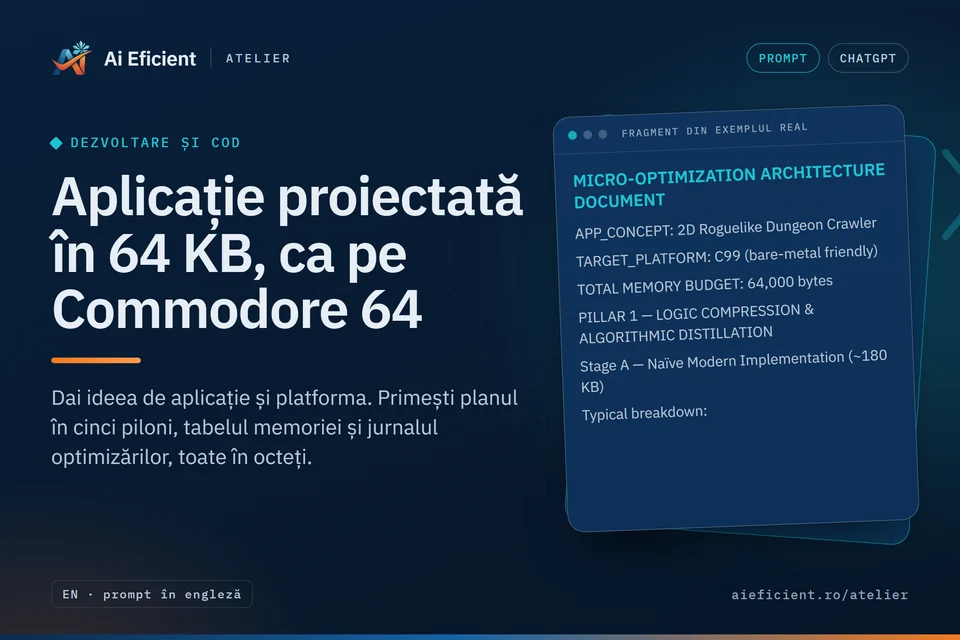
MICRO-OPTIMIZATION ARCHITECTURE DOCUMENT
APP_CONCEPT: 2D Roguelike Dungeon Crawler
TARGET_PLATFORM: C99 (bare-metal friendly)
TOTAL MEMORY BUDGET: 64,000 bytes
PILLAR 1 — LOGIC COMPRESSION & ALGORITHMIC DISTILLATION
Stage A — Naïve Modern Implementation (~180 KB)
Typical breakdown:
Restul rezultatului, încă 123 de cuvinte
Entity system (structs + vtables): ~40 KB
Tilemap engine: ~25 KB
RNG + dungeon gen: ~15 KB
Rendering abstraction: ~50 KB
AI system: ~30 KB
Inventory/loot system: ~20 KB
❌ Total: ~180,000 bytes
Stage B — Abstraction Elimination
Removal Technique Savings
OOP entity system → flat struct arrays SoA layout −28 KB
Tilemap engine → direct framebuffer indexing pointer math −18 KB
AI system → rule-based FSM in bitfields branch reduction −22 KB
Rendering abstraction → inline pixel plotting no API −40 KB
Inventory system → bitmask encoding 1 byte per slot −15 KB
✔ Intermediate: ~57 KB
Stage C — Mathematical Kernel (~9 KB core)
Core Idea:
Everything = grid + bitfields + deterministic RNG
Unified Game State (compressed)
#define MAP_W 32
Rulat pe ChatGPT GPT 5.4 la .