
Exemplul 1
Ce scrii
- Procesul
- Cement clinker production via rotary kiln
- Contextul industrial
- Heavy industry / construction materials manufacturing
- Consumul de bază
- 3.5 GJ per ton of clinker produced
- Publicul
- Plant managers and process engineers
- Formatul rezultatului
- Technical memo with decision matrix
Ce primești
Very well, domnule. Initiating a biomimetic efficiency audit of cement clinker production—one of humanity’s more… thermodynamically extravagant hobbies.
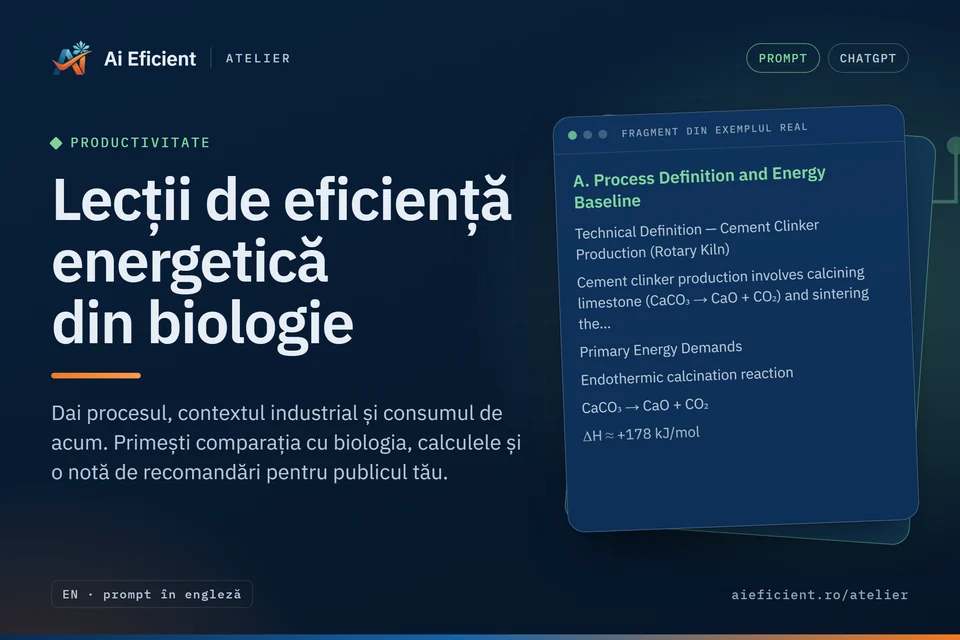
A. Process Definition and Energy Baseline
Technical Definition — Cement Clinker Production (Rotary Kiln)
Cement clinker production involves calcining limestone (CaCO₃ → CaO + CO₂) and sintering the resulting material at ~1450°C in a rotary kiln to form clinker nodules.
Primary Energy Demands
Restul rezultatului, încă 96 de cuvinte
Endothermic calcination reaction
CaCO₃ → CaO + CO₂
ΔH ≈ +178 kJ/mol
Sensible heat to raise raw meal to ~1450°C
Radiative and convective heat losses from kiln shell
Exhaust gas losses (~300–400°C typical)
Inefficient heat transfer within granular bed
Operating Conditions
Temperature: 800°C (precalciner) → 1450°C (sintering zone)
Residence time: 20–30 minutes in kiln
Atmosphere: Oxidizing (combustion gases)
Fuel: Coal, petcoke, alternative fuels
Major Sources of Inefficiency
High-temperature requirement → exponential radiative losses (∝ T⁴)
Irreversible chemical decomposition
Gas-solid heat transfer limitations
Exhaust heat loss (~20–30% of input energy)
Overprocessing due to poor selectivity/control
Energy Baseline
Rulat pe ChatGPT GPT 5.4 la .